
The Real Cost of AI: Why Strategy Matters More Than Technology
Amidst an unprecedented surge in AI investment, a stark paradox emerges: capital flows freely, yet 95% of initiatives fail to generate value. This definitive analysis moves beyond the hype to diagnose the root cause which seems to be not a technology deficit, but a profound leadership and strategic failure. Grounded in data from Deloitte, MIT, and the Bank of England, we expose the critical vulnerabilities: the 2-4 year ROI horizon that invites obsolescence, the misallocation of resources toward superficial applications, and the catastrophic miscalculation of replacing talent with unproven automation. For leaders determined to navigate this transition, we provide a decisive playbook. This includes reorienting investments toward foundational process transformation, leveraging strategic vendor partnerships proven to double success rates, and cultivating the human capabilities which AI cannot replicate and that constitute the ultimate competitive advantage. This is your guide to transcending the acquisition of technology and achieving the intelligent transformation of your organization.
Omar Berrada
12/15/202512 min read
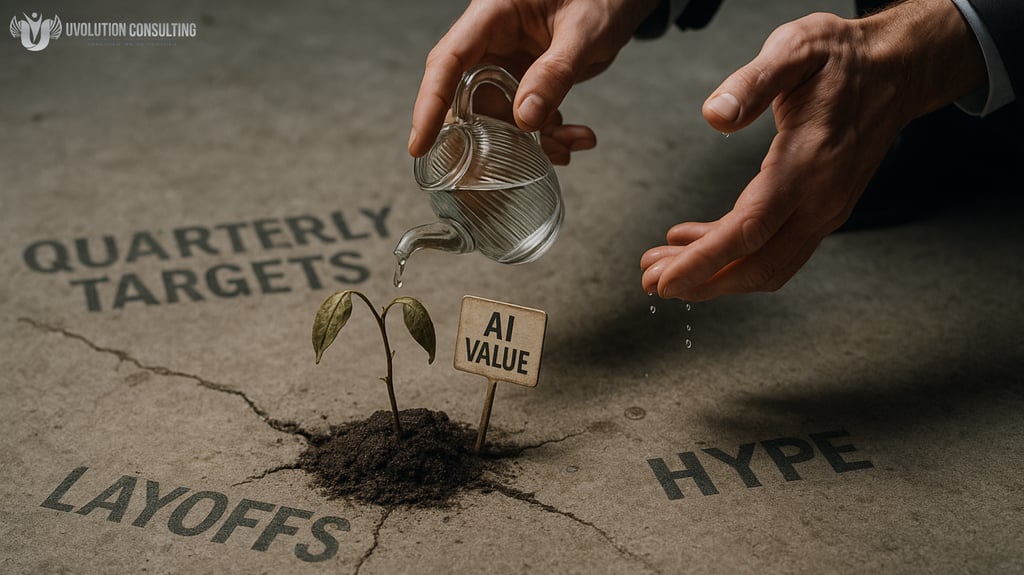

As business consultants, we are witnessing a phenomenon that is both exhilarating and deeply concerning: the Artificial Intelligence (AI) investment frenzy. Corporate boardrooms are alight with the promise of transformation, yet the reality on the ground is a profound and unsettling paradox. Unprecedented capital is being poured into AI initiatives, but for the vast majority of organizations, the expected Return on Investment (ROI) remains elusive, delayed, and often entirely absent.
This article is a necessary intervention. It is a guide for every corporate leader and business owner who feels the pressure to invest but senses the disconnect between the hype and the reality. We will take you on a journey through the current market illusion, expose the strategic missteps that are costing companies billions, and provide a clear, actionable playbook to ensure your AI strategy builds genuine, sustainable value, rather than simply fueling a bubble.
The Illusion of Immediacy and the Obsolescence Trap
The first and most critical illusion to dispel is the idea that AI will deliver immediate, cost-saving results. The narrative pushed by the market suggests that automation is just around the corner, justifying massive, urgent investment. However, the data tells a far more patient story.
According to a 2025 survey by Deloitte of executives across Europe and the Middle East, the typical payback period for a satisfactory AI use case is not months, but two to four years [2]. This is a dramatic departure from the seven to twelve months typically expected for other technology investments. Only a tiny fraction of organizations, just six percent, reported seeing a return in under a year [2].
This extended timeline is not a minor detail; it introduces a fatal flaw into the current investment model: the risk of technological obsolescence.
The AI landscape is characterized by hyper-acceleration. The models and platforms that require a two-to-four-year implementation cycle to deliver ROI are highly likely to be surpassed by cheaper, faster, or even open-source alternatives within that same period. The investment you make today in a specific proprietary technology: the infrastructure, the specialized models, the vendor contracts… runs a high risk of becoming a stranded asset before it has even paid for itself.
As leaders, you must ask: Are we investing in a long-term capability, or are we simply purchasing a rapidly depreciating asset? The long-term nature of AI’s return demands a fundamental shift in how leaders budget for and evaluate these projects, moving away from short-term pilot expectations and toward an agile, platform-agnostic strategy.
The Strategic Failure Behind the 95% Pilot Rate
The illusion of immediate ROI is compounded by the staggering rate of failure in initial AI efforts. According to MIT's NANDA initiative, which conducted extensive research including 150 interviews with business leaders, a survey of 350 employees, and an analysis of 300 public AI deployments, approximately 95% of enterprise generative AI pilots are failing to deliver measurable impact on profit and loss [3].
However, this failure is not a reflection of the quality of AI models themselves. As Aditya Challapally, the lead author of MIT's "GenAI Divide" report, explained, the core issue is not model performance but rather a fundamental "learning gap" for both tools and organizations. The problem lies in how companies are implementing and integrating these tools, not in the technology itself [3].
The research reveals a critical distinction: while only 5% of companies achieve rapid revenue acceleration from AI pilots, some startups and forward-thinking organizations are excelling. Challapally explained that successful companies "pick one pain point, execute well, and partner smartly with companies who use their tools." This demonstrates that the technology is capable and therefore the failure is in execution and strategy [3].
The failure is fundamentally a strategic and cultural failure. As business consultant Andrea Hill noted in Forbes, "The business world is not suffering from bad software. It's suffering from poor strategy, trend-chasing, and misaligned execution" [4].
The Three Pillars of Strategic Failure:
Misaligned Focus: Chasing the Hype: The MIT research reveals that more than half of generative AI budgets are devoted to sales and marketing tools: chatbots, content generation, and customer-facing applications [3]. These are simple to imagine and easy to pitch internally, but they are also where failures are most visible and the real value is lowest. The MIT study found that the biggest ROI actually comes from back-office automation: eliminating business process outsourcing, cutting external agency costs, and streamlining operations [3]. Leaders are playing in the shallow end of the pool while ignoring the deep, high-value currents of internal efficiency.
The Integration Problem: Generic tools like ChatGPT excel for individual users because of their flexibility, but they stall in enterprise use because they don't learn from or adapt to specific organizational workflows [3]. As the Deloitte survey found, AI is typically rolled out alongside broader digital, operational, or structural changes, making it nearly impossible to isolate AI's specific contribution to the bottom line [2]. It is also important to point out that many benefits such as improved employee satisfaction, better vendor relationships, or stronger customer engagement, to only cite a few, are intangible and difficult to quantify with traditional financial metrics [2]. If success is defined only by immediate, direct profit-and-loss impact, these valuable projects will be prematurely labeled as failures.
The Build vs. Buy Problem: The MIT research reveals a striking finding: companies that purchase AI tools from specialized vendors and build partnerships succeed about 67% of the time, while internal builds succeed only 33% as often [3]. This is particularly relevant as many firms in regulated sectors are building their own proprietary generative AI systems in 2025. Yet the data shows that companies see far more failures when going solo. The most effective approach is to pair internal business expertise with external implementation partners who have the proven track record of successful deployments.
The Great Miscalculation and the Looming Bubble
The most dangerous element of the current AI frenzy is the corporate reaction to the pressure to invest: the mass layoff. This is not a sign of strategic agility; it is a strategic own goal that will cause deep, long-term damage.
Layoffs as a Strategic Own Goal
Companies are shedding staff with the explicit or implicit promise that AI will automate those functions, allowing them to realize cost savings and increase share prices. This move is designed to signal to Wall Street a commitment to innovation and immediate cost-cutting. It is a powerful form of strategic signaling that manufactures the perception of agility to boost valuations.
However, this is a profound miscalculation. The employees being laid off are not just redundant costs, they are the holders of institutional knowledge, the architects of the company's culture, and the very people who understand the nuances of the business processes that AI is supposed to automate.
By pushing this talent out the door, companies are creating a vacuum of expertise that will make the successful implementation of AI more difficult. This talent will not wait on the sidelines. They will move to competitors or transition to new career paths, taking their skills and knowledge with them.
When the AI investments inevitably falter, as 95% of pilots do, and companies need to bridge the resulting performance gap, they will find that the qualified employees they need are gone, and the cost of re-acquiring that talent will be immense. The short-term budget savings from layoffs will be dwarfed by the long-term cost of a skills gap and lost institutional knowledge.
The Debt-Fueled Bubble Warning
This strategic misstep is occurring against a backdrop of systemic financial risk. The massive infrastructure build-out required to power the AI revolution is not being funded by cash flow alone; it is being fueled by debt.
The Bank of England has issued a stark warning of an AI bubble risk and the potential for a "sharp correction" in the value of major tech companies, noting that valuations are "particularly stretched" for companies focused on AI [6]. Industry forecasts suggest that spending on AI infrastructure could top $5 trillion, with a significant portion funded by outside debt [6].
This debt is creating "deeper links between AI firms and credit markets," according to the Bank of England [6]. As Fortune reported, even major players like Nvidia are effectively propping up their customers by enabling them to take on significant borrowing to purchase chips [5]. This environment creates a high-stakes scenario where the failure of a few heavily indebted infrastructure customers could ripple through the financial system. As Jamie Dimon, CEO of J.P. Morgan, has stated, he is "far more worried than others" about the risk of a serious market correction in the coming years [1] [6].
The Consultant's Playbook: Directives for Leaders
The negative outlook on AI investments is not a reason to stop, but a call to be more strategic, more patient, and less reactive. The path to real ROI lies in shifting the focus from technological novelty to fundamental business transformation.
Directive 1→ Reorient Your Investment Horizon
Accept the Timeline: Stop expecting a quick fix. Acknowledge that the ROI timeline is 2-4 years, as per the Deloitte survey [2]. Budget for the necessary organizational change management, data hygiene, and systems integration that must accompany the technology. The investment is not in the AI tool; it is in the complete overhaul of the process it touches.
Mitigate Obsolescence: To protect against the risk of rapid obsolescence, favor flexible, modular AI platforms and cloud services over massive, proprietary infrastructure investments. Your strategy must allow you to swap out underlying models and technologies as they improve or become cheaper, protecting your long-term investment in the process rather than the tool.
Measure Broadly: Move beyond narrow P&L metrics. Define success by measuring efficiency gains, productivity lifts, and cultural adoption. If a project improves employee satisfaction and reduces error rates, it is a success, even if the direct financial return is entangled with other initiatives.
Directive 2 → Augment, Do Not Annihilate Your Workforce
Stop the Strategic Own Goal: Immediately cease layoffs justified by the anticipation of AI-driven automation. The most immediate and measurable benefit of AI comes from augmenting your existing workforce, not replacing it.
Prioritize the Right Partnership Model: The MIT research clearly demonstrates that projects executed with external partners succeed at nearly double the rate of internally built efforts (67% vs. 33%) [3]. The most effective strategy is to pair internal business experts with external implementation experts. This combination of institutional knowledge and technical mileage is the only way to navigate the complexities of deployment. Do not attempt to build proprietary AI systems in-house when proven, specialized vendors and partners can deliver superior results.
Focus on Process, Not People: The goal of AI should be to eliminate the tedious, repetitive tasks within a job, not the job itself. Use AI to free up your most valuable talent for higher-value strategic work, thereby retaining institutional knowledge and fostering a culture of innovation.
Directive 3 → A Message to Leaders and the Rest of the Workforce Alike : Know Your Worth
For employees and leaders caught in this cycle, recognize this period as a passing storm driven by market anxiety, not by a fundamental shift in the value of human expertise.
The strategic errors being made by companies today such as the long ROI timelines, the high failure rates, and the loss of talent, will inevitably create a massive skills gap. More employment opportunities will surge as companies realize their mistakes.
Be warned: many corporations will attempt to "bargain-hire" this displaced talent, tapping into the desperation of those who have been unemployed for a long time. Do not let them. Your skills, experience, and institutional knowledge are more valuable than ever. This is a moment to recognize your worth and demand compensation that reflects it. The companies that understand the true cost of losing talent will be the ones that thrive in the post-hype era.
Accelerate Your Upskilling in Future-Proof Capabilities
While the market obsesses over AI automation, the most critical opportunity for your career is to deliberately invest in the skills that AI cannot replace. The future belongs to leaders and professionals who combine technical competence with irreplaceable human capabilities.
Here are some important examples, just to name a few, that you can focus your upskilling efforts on:
Emotional Intelligence: The ability to recognize what you are feeling in the moment and why, then manage those emotions so they don't derail your decisions or relationships. It also means reading the room, understanding what others are feeling and responding with empathy rather than defensiveness. Leaders with this skill don't over react in meetings or make decisions out of ego. They stay calm under pressure and bring others along with them.
Relationship Building: The capacity to create genuine trust with people, both inside and outside your organization. This is not about networking events or collecting LinkedIn connections. It means showing up consistently, keeping your word, and being the person people want to work with because you have their back. When you need something done, people move mountains for you because they know you value them.
Strategic Communication: The ability to take complex ideas and explain them so clearly that a CFO, a frontline employee, and a board member all understand exactly what you mean. It is about choosing the right words, the right tone, and the right medium so your message lands. Poor communicators create confusion and waste time; great communicators align entire organizations.
Multi-Stakeholder Influence: The skill to navigate situations where different groups want different things. You don't win by overpowering people; you win by understanding what each group actually needs, finding the common ground, and building a path forward that people believe in. This is how you move organizations forward when everyone has competing priorities.
Decision Velocity: The ability to make good decisions quickly, without analysis paralysis. You gather the essential information, weigh the trade-offs, and commit to a direction. In a fast-moving world, the leader who decides at 80% certainty and adjusts as needed beats the leader waiting for 100% certainty.
Cognitive Resilience: The mental toughness to stay clear-headed when things fall apart. You don't catastrophize; you don't blame others; you don't freeze. Instead, you assess what happened, learn from it, and move forward. This is what separates leaders who crumble under pressure from those who get stronger.
Executive Presence: The way you show up in a room. It is not about being loud or dominating conversations. It is about being fully present, speaking with conviction, and carrying yourself with the quiet confidence of someone who knows their value. People listen when you speak because you have earned their respect.
Continuous Learning Passion (Growth Mindset): The genuine hunger to get better at your craft. You don't assume you have all the answers. You stay curious, you read, you seek feedback, and you adapt. In a world where technology and business models are changing constantly, the leader who stops learning becomes obsolete.
These are some of the competencies that separate indispensable leaders from those who can be easily replaced. As AI handles routine tasks and decision-making, the premium will be placed on leaders who can inspire, influence, and guide their organizations through ambiguity and change. Invest in yourself now, in these human-centric skills, and you will be positioned not as a casualty of the AI era, but as a leader who thrives in it.
Beyond the Paradox: Building Your Competitive Advantage in the AI Era
The AI revolution is real, but the current investment cycle is fraught with peril. For leaders, the challenge is not whether to invest, but how to invest wisely. The evidence is clear: the current negative outlook is a result of strategic failure, not technological failure.
By acknowledging the long ROI timeline, mitigating the risk of obsolescence, focusing on back-office process transformation, and resisting the pressure of market hype, leaders can move past the paradox. The future of AI success belongs not to the fastest spenders, but to the most deliberate, patient, and strategically aligned organizations that treat AI as a marathon of organizational change, not a sprint of technological acquisition.
From Insight to Action: Your Path Forward
The insights presented in this article are not designed to paralyze you with fear, but rather to equip you with clarity and foresight. The AI investment bubble will inevitably deflate, organizations will recalibrate their strategies, and the talent market will fundamentally shift. What distinguishes those who thrive from those who merely survive is how strategically you position yourself for the transformation ahead.
The capabilities outlined above (emotional intelligence, relationship building, strategic communication, multi-stakeholder influence, decision velocity, cognitive resilience, executive presence, and an unwavering passion for continuous learning) are not peripheral competencies. They represent the essential foundation of executive advancement in any era, and they are particularly critical in an environment defined by technological disruption and organizational uncertainty.
If you are a mid-career leader committed to deliberately cultivating these capabilities and establishing yourself as truly indispensable, I invite you to follow my work and stay tuned for The APEX Leader Program™, launching in early 2026 at uvolutionconsulting.com. This structured 90-day transformation integrates performance psychology, peak vitality, and advanced leadership mastery into a cohesive system designed for breakthrough results.
I have designed this program drawing from 22 years of combined Fortune 50 leadership experience at Microsoft and Dell, entrepreneurial success including the building and sale of two thriving businesses, and professional certifications as a Cognitive Behavioral Therapist, Neuro-Linguistic Programming Master Practitioner, Holistic Wellness Coach, and Leadership Coach.
The APEX Leader Program™ was created specifically to address the precise gaps that prevent capable leaders from achieving their full potential and advancing to executive levels.
The inaugural cohort begins February 2nd, 2026, with only five spots available. This limited capacity reflects my commitment to delivering a premium, personalized experience where I work directly with each participant to ensure transformational outcomes.
The choice before you is clear: continue with incremental adjustments, or commit to deliberate action that shapes your future.
References
•J.P. Morgan Outlook 2026: OUTLOOK 2026: Investing in the new frontier of AI, fragmentation and inflation. (JPMorganoutlook-2026.pdf)
•Deloitte AI ROI Survey: AI ROI: The paradox of rising investment and elusive returns. (https://www.deloitte.com/se/sv/Industries/technology/perspectives/ai-roi-the-paradox-of-rising-investment-and-elusive-returns.html )
•MIT GenAI Divide Report: MIT report: 95% of generative AI pilots at companies are failing. (https://fortune.com/2025/08/18/mit-report-95-percent-generative-ai-pilots-at-companies-failing-cfo/ )
•Forbes Article: Why 95% Of AI Pilots Fail, And What Business Leaders Should Do Instead. (https://www.forbes.com/sites/andreahill/2025/08/21/why-95-of-ai-pilots-fail-and-what-business-leaders-should-do-instead/ )
•Fortune Article: Nvidia looked invincible. Now it's showing cracks. (https://fortune.com/article/nvidia-debt-jensen-huang-wall-street-artificial-intelligence-openai-chips-semiconductors-coreweave/ )
•BBC News Article: Bank of England warns of AI bubble risk. (https://www.bbc.com/news/articles/cx2e0y3913jo )
Contact:

