
The AI Bubble Is Showing Its First Cracks
The artificial intelligence investment cycle is following the same dangerous pattern as the Metaverse, NFTs, and most cryptocurrency, but with far more severe consequences. While companies have poured billions into AI technology and eliminated thousands of employees to fund these investments, the market is revealing a harsh truth: consumers don't want AI products, and 95% of enterprise AI pilots are failing. This article examines how FOMO drove irrational AI investment across industries, leading organizations to make irreversible decisions. Companies spent 93% of AI budgets on technology while neglecting the people and infrastructure needed to actually implement it. Now, as Dell admits consumers don't care about AI features and Microsoft struggles to sell its AI products, the correction is underway.
Omar Berrada
1/10/20267 min read
The pattern is becoming impossible to ignore. We have seen this movie before multiple times. The Metaverse promised to revolutionize human connection and commerce. Non-fungible tokens were supposed to democratize digital ownership. Cryptocurrency would replace traditional finance. Each cycle followed the same script: visionary promises, massive capital deployment, widespread adoption by corporations and investors, and then, inevitably, the reckoning.
Now we are watching the same cycle play out with artificial intelligence, except this time the consequences are far more severe. Companies have not just invested billions in AI technology; they have fundamentally restructured their organizations around it. They have eliminated the very talent that built their success, betting everything on the promise that AI will replace those workers and deliver unprecedented returns. The question is no longer whether the AI bubble will burst, it is whether organizations will survive the fallout when it does.
The FOMO Machine: How Fear Drove the AI Gold Rush
The AI investment frenzy was not born from rational analysis. It was born from fear. According to the J.P. Morgan Outlook for 2026, the financial system is exhibiting five elements of irrational exuberance: unsustainably high valuations, stretched sentiment, complacency about downside risks, excessive leverage, and crowded positioning. The AI sector exhibits all five. Wall Street has rewarded companies for their AI announcements, not their AI results. Investors have punished companies that did not aggressively pursue AI, regardless of whether it made strategic sense for their business.
This created a perverse incentive structure. CEOs faced a choice: invest heavily in AI and be celebrated by the market, or maintain a measured approach and watch your stock price stagnate while competitors received the "innovation premium." The choice was obvious. The fear of being left behind, of missing the next computing revolution, overrode any cautious analysis of actual return on investment.
As Deloitte's CTO Bill Briggs observed, companies are spending 93% of their AI budgets on technology and only 7% on people. This imbalance reveals the true nature of the AI rush: it is not a strategic investment in organizational capability. It is a panic-driven attempt to appear innovative while cutting costs. The technology is the easy part. The hard part is transforming organizations, retraining workforces, and building sustainable competitive advantage, has been almost entirely neglected.
The Layoff Gambit: Destroying Value While Chasing Returns
The most troubling manifestation of AI-driven FOMO has been the wave of mass layoffs justified by AI investment. Companies have eliminated support functions, back-office operations, and middle management, the very infrastructure that enables organizations to execute strategy and adapt to change. The logic was seductive: if AI will automate these roles, why pay for them now?
But here is what the data actually shows. According to MIT's NANDA initiative, which conducted extensive research including 150 interviews with business leaders and analysis of 300 public AI deployments, 95% of enterprise generative AI pilots are failing to deliver measurable impact. The MIT research reveals that the failure is not due to poor AI models, but rather a fundamental "learning gap" for both tools and organizations. The problem is implementation and integration, not technology quality.
Yet companies that eliminated the people who understand their business processes, the researchers, analysts, and operational experts who could have bridged that gap, are now discovering they have no one left to actually make AI work. McKinsey's announcement of 10% workforce cuts (a few thousand jobs phased over 18-24 months) is particularly telling. The consulting firm that has spent decades advising clients to invest in AI and automation is now cutting its own support functions. But here is the critical insight: they are not cutting client-facing roles. They are cutting the infrastructure that enables their consultants to deliver value.
This reveals an uncomfortable truth that most organizations have not yet grasped: AI will not replace the roles that require human judgment, relationship-building, and strategic thinking. It will replace the roles that support those people. If you have already eliminated your support infrastructure to fund AI, you have created a massive vulnerability. When your AI implementation falters, and statistically, 95% of them do, you will have no one left who understands how to fix it.
The Consumer Rejection: The Market Speaks
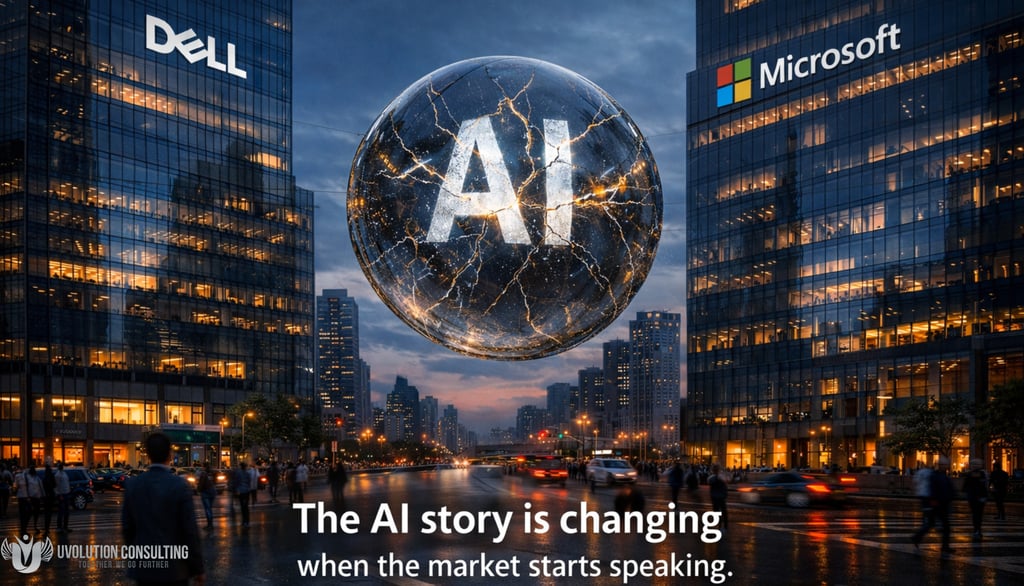
The most recent evidence that the AI bubble is deflating comes from the market itself. Dell, one of Microsoft's largest PC partners, has admitted that consumers simply do not care about AI features. In an interview with PC Gamer, Kevin Terwilliger, Dell's head of product, stated bluntly: "They're not buying based on AI. In fact I think AI probably confuses them more than it helps them understand a specific outcome."
This is a stunning admission from one of the world's largest technology companies. Dell invested heavily in AI PCs, partnering with Microsoft on the Copilot Plus PC launch in 2024. Yet after a full year in the market, the company has discovered that consumers are buying for improved battery life and performance, not for AI features. The AI capabilities that were supposed to drive the next generation of computing adoption are, in the words of a major PC manufacturer, confusing consumers more than helping them.
Microsoft, meanwhile, is facing an even more severe problem: its AI products are simply not good enough. According to Windows Central, Microsoft's sales people are struggling to meet AI product sales goals due to a complete lack of demand. The company has cut internal forecasts and sales goals for Azure AI products across the board. Meanwhile, Google Gemini is actively outpacing Microsoft Copilot in market share, with research showing that Google's AI products are more thoughtful, more polished, and actually useful for real-world tasks.
The contrast is stark. Microsoft's "ship it now, fix it later" strategy has resulted in half-baked AI features across its product line, from Copilot 365 to Teams to the Photos app. These features are not just underperforming; they are damaging Microsoft's reputation. As one analyst noted, Microsoft's approach risks giving its AI products an Internet Explorer-like reputation for poor quality. Meanwhile, Google has invested more time in thoughtful implementation, and the market is responding accordingly.
A Historical Pattern But This Time It Is Different
The Metaverse, NFTs, and cryptocurrency all followed the same pattern. Visionary promises. Massive capital deployment. Corporate adoption driven by FOMO. And then, when the technology failed to deliver on its promises, the market corrected sharply. Meta lost $70+ billion on its Reality Labs metaverse division before finally cutting spending by 30%. Countless companies invested in NFT initiatives that generated minimal engagement or ROI. Cryptocurrency exchanges collapsed, taking billions in investor capital with them.
But here is why the AI bubble is more dangerous: the previous cycles were largely contained to specific sectors or use cases. The Metaverse was a bet on a new platform. NFTs were a bet on digital ownership. Cryptocurrency was a bet on replacing traditional finance. Companies that made bad bets in these areas suffered, but the broader economy continued functioning.
The AI bubble is different because it has infected every sector and every organization.
Companies have not just invested in AI; they have restructured their entire organizations around it. They have eliminated talent, reorganized reporting structures, and redirected capital flows based on the assumption that AI will deliver transformational returns. When that assumption proves false, and the market evidence suggests it already is, the consequences will be systemic
The Talent Trap: A Vulnerability Disguised as Cost Savings
The most insidious aspect of the AI-driven layoffs is that they have created a long-term competitive vulnerability disguised as short-term cost savings. Companies that eliminated support staff to fund AI investments have destroyed institutional knowledge that took years to build. When those organizations eventually need to hire back, and they will, they will face a market where the best talent has moved to competitors or changed careers entirely.
According to Deloitte's TrustID report, despite increased access to generative AI in the workplace, overall usage has actually decreased by 15%. Furthermore, 43% of workers with access to gen AI admit to noncompliance, bypassing employer policies to use unapproved tools.
Corporate worker trust in gen AI has declined by 38% between May and July 2025. The research shows that workers who received meaningful, hands-on training reported 144% higher trust in their employer's AI than those who did not.
This reveals the real problem: organizations have invested in technology while neglecting the people who must use it. They have eliminated the support infrastructure that could have helped bridge the gap. And they have destroyed employee trust in the process. When the AI bubble deflates, and it is deflating right now, these organizations will discover that they have no infrastructure to fall back on, no experienced staff to rebuild with, and a workforce that has lost confidence in management's strategic judgment.
The Reckoning: What Comes Next
The evidence is mounting that the AI investment cycle is entering its correction phase. Dell is shifting away from "all about the AI PC." Microsoft is cutting AI sales forecasts. Consumers are rejecting AI-first products in favor of products that work well, regardless of AI features. The technology that was supposed to revolutionize business is proving to be half-baked, confusing, and often less effective than simpler alternatives.
This does not mean AI will disappear or prove useless. Like the internet, electricity, and other transformative technologies, AI will eventually find its place in the economy. But that place will be far more limited than the current hype suggests. AI will automate specific, well-defined tasks. It will augment human decision-making in certain domains. It will improve efficiency in back-office operations. But it will not replace human judgment, creativity, relationship-building, or strategic thinking. And it certainly will not deliver the kind of transformational returns that justified the massive capital deployment and organizational restructuring of the past two years.
The organizations that will suffer most are those that have already made irreversible decisions based on the assumption that AI would deliver immediate, dramatic returns. They have eliminated the talent that built their success. They have destroyed the support infrastructure that enables execution. They have damaged employee trust through poorly conceived AI implementations. And they have invested billions in technology that consumers do not want and that does not work as promised.
The companies that will thrive are those that take a more measured approach. They will invest in AI where it makes genuine strategic sense. They will protect their support infrastructure and institutional knowledge. They will invest in training and change management to build employee confidence. They will focus on delivering genuine value to customers, not on appearing innovative to investors. They will treat AI as a tool to be deployed strategically, not as a panacea that justifies any organizational decision.
The AI bubble is not a question of if, but when. The market is already showing signs of correction. The question now is whether organizations will learn from the Metaverse, NFTs, and cryptocurrency cycles, or whether they will repeat the same mistakes on an even larger scale. The evidence suggests they will not. And when the correction comes, the organizations that have already destroyed their support infrastructure and eliminated their most experienced talent will discover that they are uniquely vulnerable to the fallout.
The FOMO that drove the AI investment cycle is giving way to a different emotion: regret. And for many organizations, that regret will prove far more expensive than any AI investment could ever justify.
Contact:

