
Character vs. Charisma: Why the Most Magnetic Leaders Often Fail
At a critical point in career growth, leaders must choose between charisma and character. This article explores why visibility, personal branding, and political skill fail without real capability, and how sustainable leadership is built through skill mastery, self-leadership, physical resilience, and character development. Learn why substance outperforms image, how earned authority is created, and what it truly takes to rise into executive leadership with long-term impact, credibility, and performance.
Omar Berrada
1/28/20269 min read
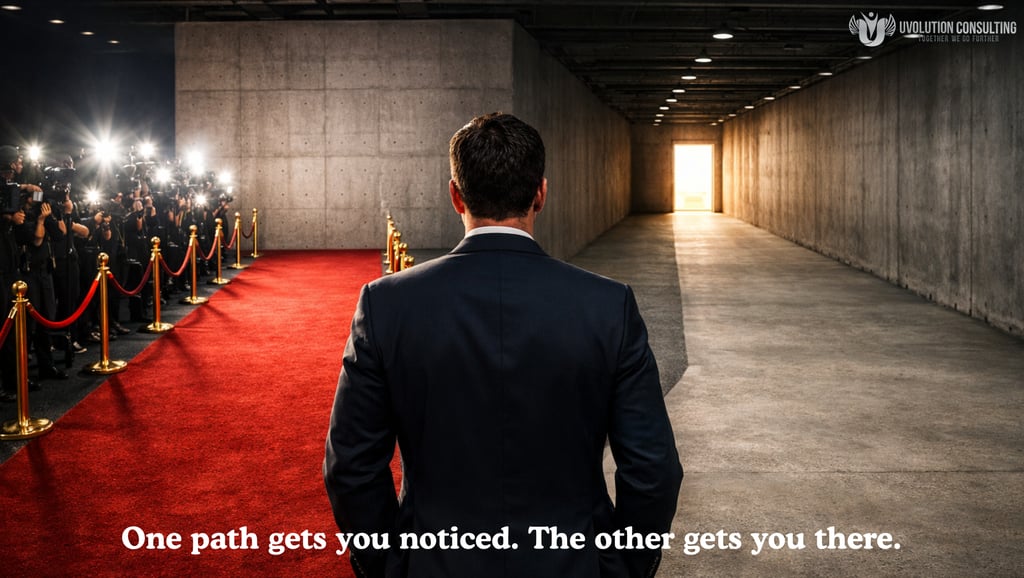
There is a moment that arrives in every ambitious professional's life. It does not announce itself. It does not come with a clear sign or a warning. But it is real, and the choice you make in that moment shapes everything that follows.
It is the moment you decide how you will rise.
One path promises speed. It is the path of image, positioning, and political navigation. You learn to read the room, to say what lands well, to build visibility with the right people. You craft a personal brand. You study what gets rewarded and you optimize for it. You become someone who looks like a leader, sounds like a leader, and moves through the organization like someone destined for more.
The other path offers no such promises. It is slower, quieter, and far less glamorous. It is the path of skill, substance, and relentless self-improvement. You focus on becoming genuinely valuable rather than appearing valuable. You build capabilities so deep that your contribution eventually speaks louder than any personal brand ever could.
Most ambitious people feel the pull of the first path. And why would they not? Organizations often reward visibility over value. The person who speaks confidently in meetings frequently advances faster than the one who quietly delivers results.
So they choose the fast path. They learn to perform confidence before they have earned it. They network strategically rather than connect authentically. They position themselves for the next role instead of mastering the one they have.
For many of them, this works. For a while.
The Unraveling
I have spent more than two decades watching careers unfold. Twenty-two years inside Fortune 50 companies as well as building two businesses from nothing and eventually selling them. Thousands of conversations with leaders at every level.
And I have seen a pattern repeat itself so many times that I can now recognize it from the beginning.
The charismatic leader who inspired deep loyalty but could not retain talent once the initial excitement faded. The executive who rose through political skill but collapsed when they finally reached a role that required real capability. The manager who was celebrated in company meetings but whose team privately dreaded working for them.
They all made the same mistake. They built their leadership on the wrong foundation.
There is research that should unsettle anyone who has built their career on presence and inspiration. Studies on what actually drives development outcomes discovered that your techniques, your frameworks, your ability to command a room, your capacity to inspire in the moment... all of it accounts for roughly fifteen percent of your impact.
Fifteen percent.
The rest comes from factors that have nothing to do with how magnetic you are. Forty percent comes from the people you are leading, their readiness, their motivation, and their environment. Thirty percent comes from the quality of the real relationships you have built with them. Another fifteen percent comes from their belief that the path you are on together will actually lead somewhere meaningful.
The leader who pours their energy into charisma is working the smallest lever available while ignoring the ones that actually move things.
But the problem runs deeper than ineffectiveness.
Charisma has a structural flaw that character does not possess. Charisma creates dependency. Character creates capacity.
Think about what charismatic leadership actually demands. It requires you to be the constant source of energy, direction, and inspiration. Your presence must lift the room. Your words must motivate. This sounds like leadership. It feels like leadership. But it is actually a trap.
Because the moment you are not there, the energy leaves with you. The team that seemed so capable suddenly cannot function. The organization that appeared strong reveals itself to be hollow at the center.
Two Leaders, Two Legacies
History offers us a stark illustration.
Consider one of the most celebrated military leaders who ever lived. He built an empire that stretched across multiple continents. He led his soldiers personally into battle after battle. His tactical genius was undeniable. His ability to inspire loyalty was extraordinary. Men followed him across the known world because his presence made them believe they could achieve the impossible.
But even his devoted soldiers eventually grew weary. And when he died young, his empire began fracturing almost immediately. His generals turned on each other. Within a generation, nearly everything he had created was gone.
Today he is studied by historians. But his influence on how people actually live, lead, and treat each other is essentially zero. He built something enormous that could not survive without him.
Now consider a different kind of leader from the ancient world.
This man was a philosopher who found himself thrust into political power. By all accounts, he did not seek the role and often found it burdensome. He was not known for stirring speeches or magnetic presence. Instead, he spent his evenings writing private reflections that he never intended for anyone else to read. Notes to himself about duty, self-discipline, and how to treat other people with fairness and wisdom.
Two thousand years later, those private notes are still being read. Leaders in business, government, and military service keep his words close at hand. His reflections on character and self-mastery feel as relevant today as they did in ancient Rome.
The difference between these two men comes down to a single distinction.
One built his influence on his presence. When his presence ended, so did his influence.
The other built his influence on his character. His principles were so solid, so genuinely lived that they could be transmitted across centuries without him needing to be there at all.
This is the fundamental asymmetry. Charisma must be constantly renewed because it depends on performance. Character generates its own momentum because it is rooted in something real.
The Fork You Are Standing At
The charisma path looks like this. You identify what your organization rewards and you optimize for it. You study the politics, learn who holds influence, and position yourself to be noticed by them. You practice projecting confidence even when you feel uncertain. You build relationships strategically, always with an eye toward what each connection might do for your advancement.
This path produces leaders who become skilled at appearing to lead. They interview well. They present with polish. They manage upward brilliantly. In organizations that confuse performance with competence, they rise.
But they carry a burden that never goes away. The quiet fear of being found out. Because underneath the polished exterior, they know the gap between their image and their actual capability. Every new challenge feels like a threat. Every difficult situation carries the risk that their limitations will finally become visible.
The character path looks different.
You identify what actually creates value and you work to master it. You develop skills so thoroughly that your competence becomes impossible to ignore. You build relationships based on what you genuinely contribute. You pursue growth especially when it is uncomfortable, because you understand that discomfort is where real development happens.
This path is slower. The person walking it often watches charismatic peers get promoted ahead of them.
But the character path produces something the charisma path never can. It produces earned authority.
When you have genuinely mastered your work, you do not need to project confidence. You possess it. When you have built real relationships through real contribution, you do not need to manage how people perceive you. They already know who you are. When you have held yourself accountable in private, you do not walk around fearing exposure.
There is nothing to expose.
This is why legitimate leadership always begins with self-leadership. You cannot effectively lead others until you have learned to lead yourself.
What Character Actually Requires
Character is not something you are born with. It is not a fixed trait that some people have and others lack.
Character is something you build. It is constructed choice by choice, day by day, through hundreds of decisions that most people will never see.
Think of a craftsman shaping raw material into something refined. The material was always there, but the finished work only emerges through deliberate, patient, repeated action. Every choice shapes what the final creation will become.
Character works the same way.
Every time you choose the harder right instead of the easier wrong, you are shaping your character. Every time you hold yourself to a standard that no one else is enforcing, you are shaping your character. Every time you resist the temptation to cut corners, to manage appearances instead of realities, you are shaping your character.
The research on expertise development confirms this. Becoming genuinely excellent at anything requires deliberate practice. Focused effort to improve specific capabilities, with particular attention to the areas where you are weakest. Getting honest feedback and actually using it. Pushing past the point where things feel comfortable.
Most people will not do this work. They will settle for whoever they have accidentally become rather than intentionally shaping who they are becoming.
But character development has a quality that makes it different from almost any other investment.
The more you draw on character, the stronger it becomes. Unlike a resource that depletes with use, character regenerates. The discipline you exercise today makes tomorrow's discipline slightly easier. The integrity you demonstrate in one situation strengthens your capacity for integrity in the next.
Charisma is the opposite. It depletes with use. It requires constant performance to maintain.
This is why charismatic leaders so often burn out while leaders of character seem to strengthen with age.
The Physical Foundation No One Talks About
There is a dimension of character development that almost no one discusses.
Character requires energy. Sustained excellence requires physical capacity. The choices that build character, the discipline to hold yourself accountable, the resilience to keep developing when progress is slow... none of this is possible if you are physically depleted.
If you are surviving on caffeine and stress hormones, if your sleep has been compromised for months, if you have not moved your body with intention in longer than you can remember... your capacity is constrained at a biological level.
No amount of mindset work overcomes a nervous system that is constantly in survival mode. No amount of skill development compensates for a brain that is not getting the rest it needs.
This is why character development cannot be separated from physical development. They are one integrated challenge.
The leaders I have watched sustain excellence over decades are almost always the ones who treated their physical foundation as seriously as their professional development. Not as a luxury. As a non-negotiable part of becoming who they were capable of becoming.
A Framework for the Path Forward
If you are ready to commit to building character rather than cultivating charisma, here is how to begin.
Start with an honest audit. Get clear about the gap between your current image and your current capability. Where have you been performing confidence you do not actually feel? Where have you been optimizing for how things look rather than how things are?
Identify your real development work. What capabilities, if you built them fully, would make your value undeniable? Not the skills you are already strong in. The ones you have been avoiding because they are hard, because they require you to be a beginner again.
Build the physical foundation. Audit your sleep, your movement, your nutrition. These are not separate from your leadership development. They are the base that everything else rests on.
Install reflection as a discipline. Character develops through examined experience. At the end of each day, take one minute: What choice did I make today that built character? What choice eroded it? At the end of each week: Where did I grow? Where did I take the easier path?
Find genuine accountability. Character built in isolation is fragile. You need at least one relationship where you tell the complete truth about your progress and your failures.
The Responsibility We Carry
I need to say something about my own profession.
The fields of consulting and coaching carry a particular temptation. It is the temptation to build a practice on charisma rather than character.
I have watched practitioners more focused on appearing impressive than being genuinely helpful. Who use techniques designed to create emotional dependency rather than build real capability. Who keep clients engaged not because those clients are still developing but because they have never been taught to succeed without ongoing support.
This is the charisma trap applied to development work. It looks like helping. But it is actually dependency creation dressed up as service.
This is why I describe what I do as consulting rather than coaching. My work is designed around a different outcome. I work with leaders intensively for ninety days. The goal is to build their capability so completely that they genuinely do not need me when we are finished.
This means working on all the dimensions that character requires. Not just mindset, but identity. Not just leadership skills, but the physical foundation that sustains them. Not just goals, but the psychological architecture that makes achievement sustainable.
And at the end, I build them a twelve-month continuation plan. A roadmap for ongoing development that does not require my involvement.
Because if my value depends on their continued dependency, I have not actually built their capability. I have just created a more sophisticated version of the trap I am warning them about.
Your Invitation
On April 20th, I am launching the APEX Leader Program.
It is a ninety-day intensive for leaders who are done performing leadership and ready to start embodying it.
This program is for you if you have felt the pull of the charisma path and recognized it as a trap. If you are tired of managing perceptions and ready to build capabilities so real that perception becomes irrelevant. If you understand that the career and life you want requires becoming someone worthy of them.
We will work on all of it. The psychology of genuine confidence. The leadership skills that create real impact. The physical optimization that provides energy and vitality across decades. And we will build you a twelve-month plan for continued growth that does not depend on my ongoing involvement.
I am accepting ten founding members for this cohort.
If this resonates, reach out. Not to become a permanent client. To become the leader you are capable of becoming, with or without me.
Because that is what character development produces. People who have built something inside themselves that generates its own light.
Contact:

